Grand Strategy · Adaptive AI

THE
GREAT
CONFLICT

The AI remembers.
Every campaign changes the next.
Alliances form. Strategies escalate.
No two wars are alike.

Wars Simulated
Decisions Evaluated
Active Campaign Paths
0
Identical Games
Technology

Your Opponent Has a
Long-Term Memory

The era of static scripts is over. The ONNX-based wargame AI analyzes your tactical preferences across multiple playthroughs. It plans multi-round offensives, coordinates allies and recognizes your patterns — before you spot them yourself.


Do you always attack with tanks across the eastern flank? The next campaign will greet you with concentrated anti-tank defenses right there. The AI does not forget.

> TARGET EVALUATION: ACTIVE
Germany Primary: Op. BlitzRussia
Japan Directive: IndiaCrush
Alliance Goal: Capture India
Campaign Phase: STAGING → EXECUTION
Confidence: 72.4%
>> Adjusting to Player_Pattern_04...
Live Demo

Last AI Conflict

The AI plays against itself around the clock. Here you see the course of the last completed battle — strategy by strategy, round by round.

OPERATION LOG — AI vs AI
Loading data…
■ AXIS ■ ALLIES · Strategy · Front Pressure · Threat
Connecting to AI server…
The Game

War is No Longer
an Algorithm

The Great Conflict is a grand-strategy simulation where you command armies, manage resources and make decisions — against an AI that learns from your mistakes.


Built for strategy enthusiasts who demand more: not just winning a game, but facing an intelligence that evolves with every match. No scripts. No fixed patterns. Genuine adaptive resistance.

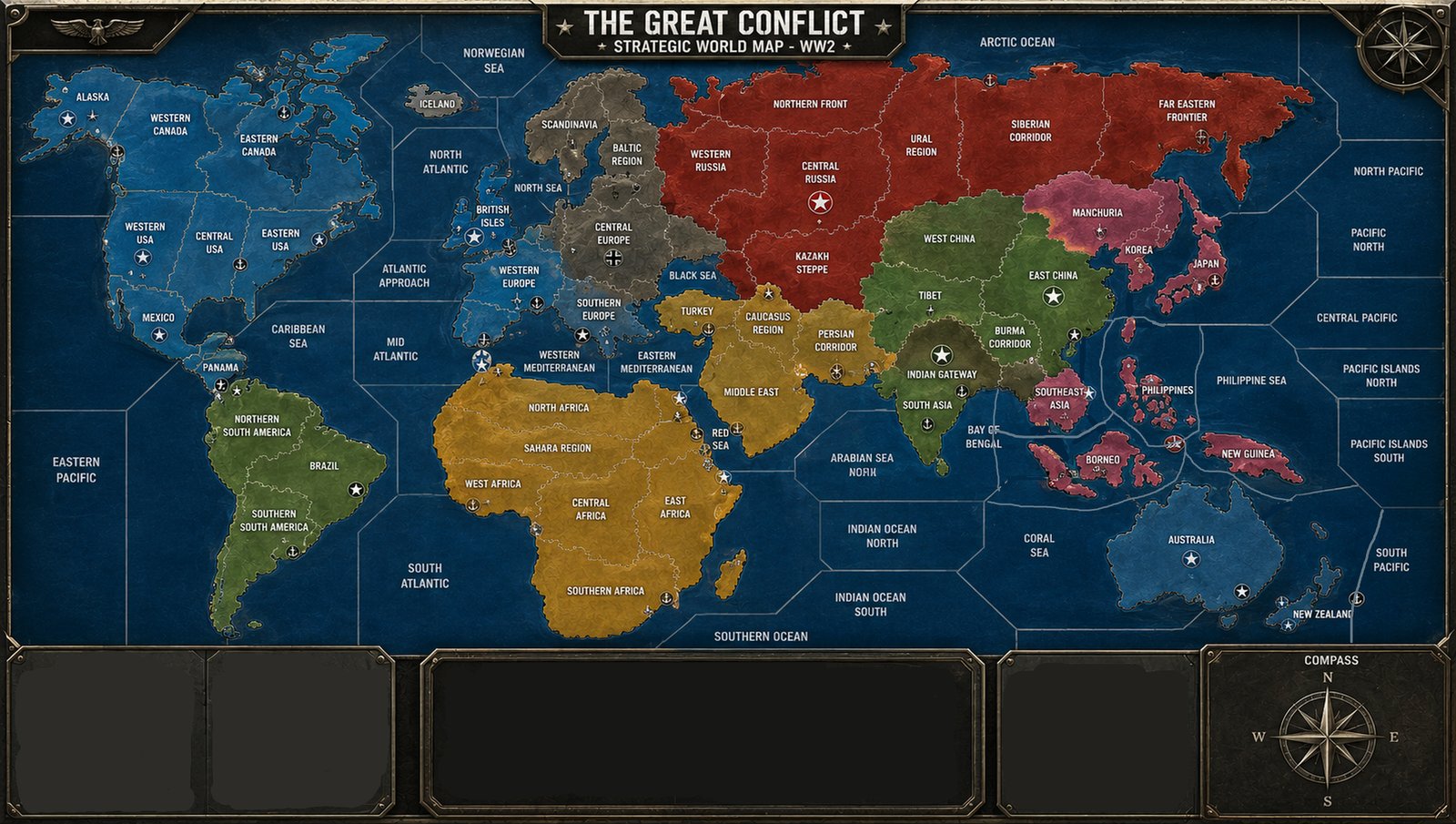
Screenshot: Battlefield overview in The Great Conflict
System Architecture

The Anatomy of the
War AI

Campaign Planning

The AI does not think in individual rounds — it plans large-scale offensives across multiple game phases. Objectives are pursued long-term and dynamically adjusted when faced with strong resistance.

  • Multi-round build-up phases
  • Coordinated attack timing
  • Response to front-line changes

Alliance Coordination

Allied nations do not act in isolation. They react to each other, exchange strategic priorities and execute coordinated pincer attacks on a global scale.

  • Real-time alliance signals
  • Aid requests & responses
  • Emergent joint offensives

Long-Term Memory

After every conflict the AI evaluates its strategic decisions. Successful campaigns are preferred, defeats lead to new approaches — across game sessions.

  • Learns from every defeat
  • Adapts to your play style
  • Remembers your patterns

Dynamic Warfare

Battles evolve organically. No fixed script — only chaos, strategy and the will to win. Every decision has consequences throughout the entire match.

Global Battlefield

Command multiple nations simultaneously. Operations in Europe, Asia and Africa influence each other — every front is part of a larger picture of war.

Post-Battle Analysis

Learn from every defeat. The analysis system shows you exactly where the AI outsmarted you — and which strategy it will deploy next time.

Transparency Report

How Good Is Our
AI, Really?

The Great Conflict runs on an unusually layered AI: a core rule-based logic, a learned model, a long-term memory system, and several other pieces that are meant to work together. But does every one of these pieces actually help? Rather than assume so, we tested it — with hundreds of automatically played games and real statistics, not just intuition.

What We Did

We switched off individual AI components one at a time and checked whether the Axis powers performed worse as a result. In the first pass, it looked like one particular coordination system was essential for everything else to work. On closer inspection, that turned out to be a software bug that had accidentally silenced this system across every test run — not a genuine dependency. We found the bug, fixed it, and reran the test cleanly.

The Honest Result

After the fix, we could not demonstrate a clear, independently measurable effect on win rate for any single component tested. That doesn't mean these systems are useless — it means their individual contribution is either small, or only shows up in combination with everything else, in a way our current sample size can't yet cleanly separate. We'd rather say that plainly than claim a positive result we can't actually back up.

Why This Is Still a Good Outcome

Along the way, we uncovered several real, independent bugs we might never have found otherwise — and fixed them. That's the actual point of a study like this: not just confirming what you expect, but surfacing what's actually going wrong. This isn't a one-time exercise: even as we write this, we're systematically working through further, independently found bugs — the AI is under continuous review, not just checked once for this study.

How Much Testing Is Behind This?

This ablation study alone involved over 2,000 automatically played test games — computer versus computer, so we could measure effects at a scale that would never occur in normal play. A further, continuously growing test run is currently underway in parallel, among other things to check how well the AI plans and executes rare, historically difficult operations like an invasion of Britain (Operation Sea Lion).

What Can I Expect From the AI Opponent as a Player?

Honestly: an AI that plans across multiple layers — look-ahead evaluation, learning components drawn from past games, and coordination between factions — but not an unbeatable or flawless opponent. This study itself shows that: we couldn't demonstrate a clearly measurable strength gain for individual AI components on their own, and the Axis powers structurally struggle to convert an advantage into an actual win — that holds regardless of whether a human or the AI controls them, and is a known balance property we're working on. All figures so far also come from computer-versus-computer games; how that feels against a human opponent may differ. What we can promise: an AI that's tested seriously, with real statistics, and whose weaknesses we'd rather disclose than hide.

And What Does It Feel Like Against a Human?

That's something we honestly can't answer with confidence yet. Every number in this study comes from computer-versus-computer games — which tells us something about how AI components behave toward each other, but nothing about what a game against the AI actually feels like: whether you're facing an opponent worth taking seriously, or something closer to a rule mechanism working through a checklist. What we can say: architecturally, the AI isn't built on simple if-then rules — it plans ahead, tries to read opponent behavior, and coordinates across factions, which is a different thing from a rigid rulebook. Whether that translates into a "real opponent" feeling at the table is an open, honest question we can't yet answer with data.

Human-versus-AI isn't just something planned for later, either: these games are already a normal way to play today, and that data already feeds into the AI's learning pipeline (weighted lower than pure AI-vs-AI games, so individual human playstyles don't disproportionately skew training). So the AI does learn from games against real players in principle — we just can't yet make a solid claim about how strongly or how quickly that shows up, until enough of these games have been systematically evaluated.

Insights

From the
Battlefield

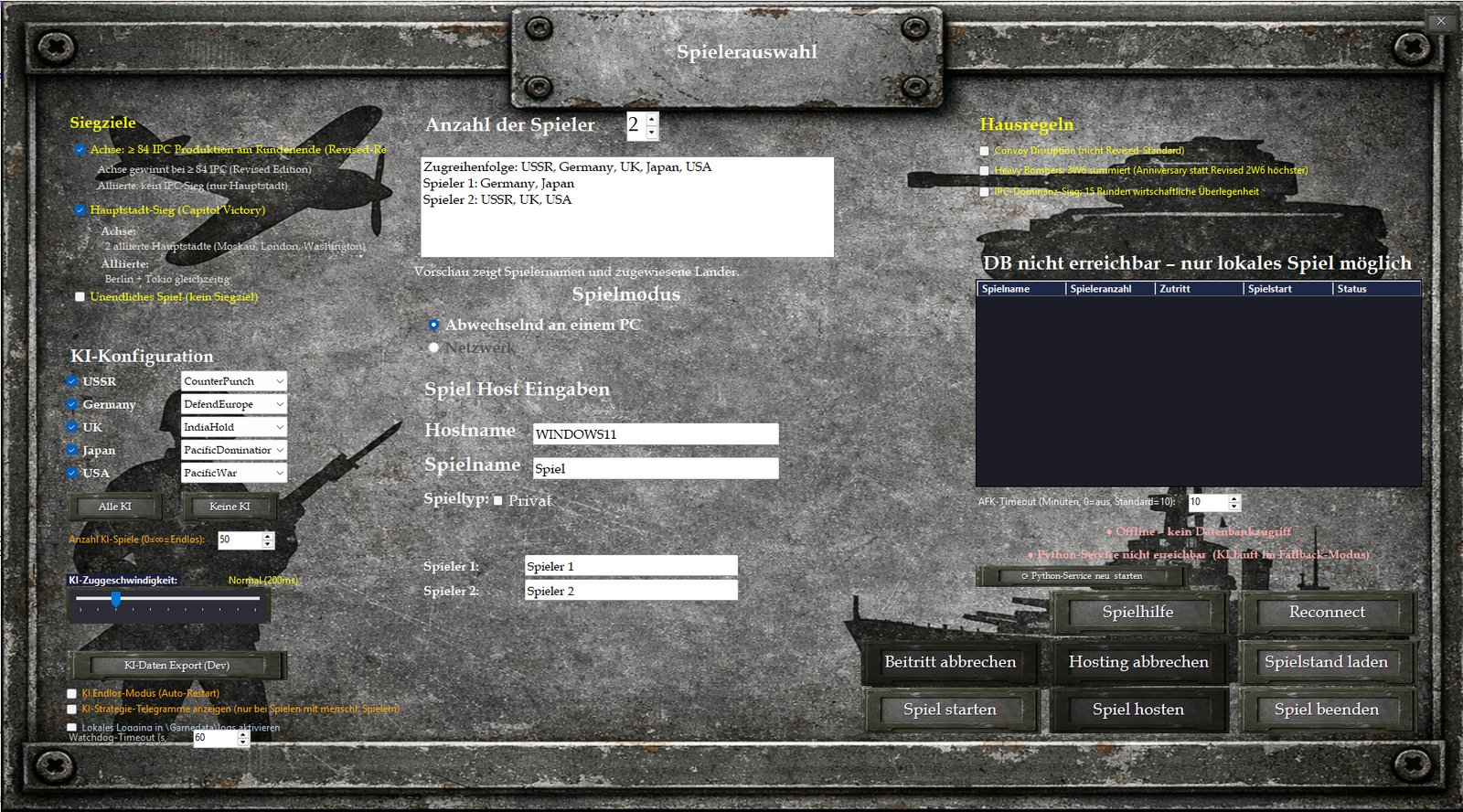
Screenshot: Game overview
Screenshot: AI Analysis
📷
Screenshot coming soon
📷
Screenshot coming soon
Beta Test

Fight at the
Front of Development

Before the official release, selected commanders test the current build directly against the server AI. Register for free to get beta access — the download runs directly from our own server, no Steam key required.

Free · No credit card required · Windows 10/11 · Feedback directly to the dev team

Commanders already on board
Steam

Ready for the
Conflict?

Add The Great Conflict to your Steam wishlist now. You will be notified immediately when the game releases. Every wishlist helps us publish the game.

🔓 Free · No registration required
Newsletter

Miss No
Update

Get exclusive devlogs, alpha access and release news directly in your inbox. We send at most twice a month.